
BreizhCTF 2023 - Love, Death & Robots
Challenge details
| Event | Challenge | Category | Points | Solves |
|---|---|---|---|---|
| BreizhCTF 2023 | Love, Death & Robots | Mobile | ??? | ??? |

“Me, a robot? seriously ^^ haha nobody’s pulled that one on me in aaages :) ask my buddies if I’m a robot you’ll see the kind of answers you’ll get XD … I think I’m the least robot guy in my crew of 11 best friends!” — ChatCPT
Disable the android with the administrator password before it becomes uncontrollable.
Author: Zeecka
TL;DR
The application, developed in Kotlin, encrypted the supplied password with a TEA Cipher algorithm whose constants had been slightly modified. It then checked the encrypted result against a string embedded in the application.
Methodology
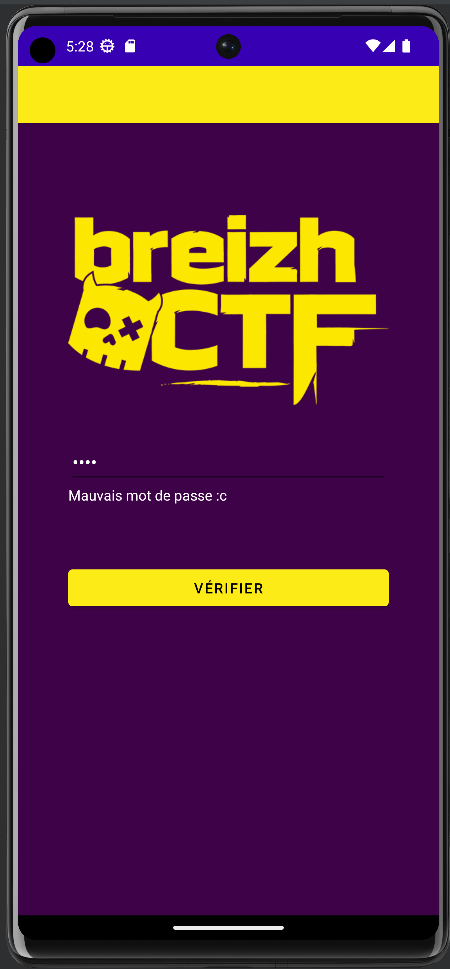
When we open the provided APK in an Android VM, we are prompted for a password:
In order to decompile and easily navigate the application, we open it with the jadx-gui application.
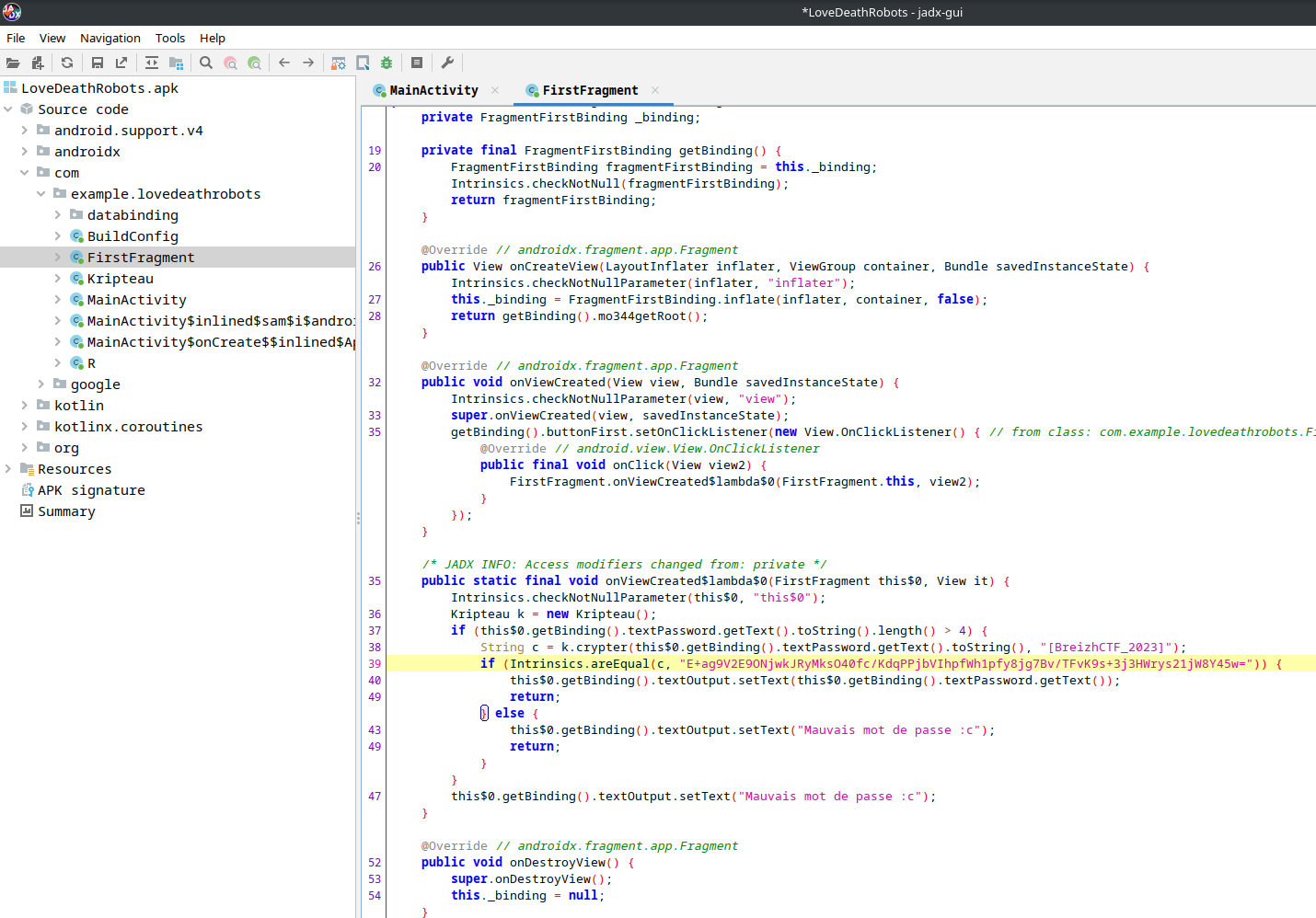
We quickly identify 2 interesting classes:
- FirstFragment (corresponding to the main activity)
- Kripteau (contains the cryptographic routines)
A first read shows that the message supplied by the user must equal E+ag9V2E9ONjwkJRyMksO40fc/KdqPPjbVIhpfWh1pfy8jg7Bv/TFvK9s+3j3HWrys21jW8Y45w= once encrypted with Kripteau.crypter() and the key [BreizhCTF_2023].
To make it easier to read, here is the source code of Krypteau.kt:
package com.example.lovedeathrobots

import java.lang.Integer.min
import java.util.*

class Kripteau {

    fun crypter(s: String, k: String): String{
        var sb = _str2vec(s)
        var kb = _str2vec(k)
        var o = byteArrayOf()
        for (i in 0..(sb.size-1) step 2) {
            val v = listOf(sb[i], sb[i+1])
            o += _vec2str(_crypter(v, kb))
        }
        return String(Base64.getEncoder().encode(o))
    }
    fun _crypter(v: List<Long>, k: List<Long>): List<Long>{
        val d: Long = (0xBC7F2023).toLong()
        var y: Long = v[0]
        var z: Long = v[1]
        var sum: Long = 0L
        for (x in 32 downTo 1) {
            sum += d
            y = ((y + ((((z shl 4) + k[0]) xor (z + sum)) xor ((z shr 5) + k[1]))) and 0xFFFFFFFF)
            z = ((z + ((((y shl 4) + k[2]) xor (y + sum)) xor ((y shr 5) + k[3]))) and 0xFFFFFFFF)
        }
        return listOf(y, z)
    }
    fun _str2vec(s: String):  List<Long>{
        val charset = Charsets.UTF_8
        var n = s.length
        // Split the string into chunks
        var numchunks = kotlin.math.ceil((n.toDouble() / 4)).toInt()
        var chunks: Array<ByteArray> = arrayOf()
        for (i in 0..(numchunks-1)){
            val sub = s.substring(4 * i, min(4 * (i + 1), n))
            chunks += (sub).toByteArray(charset)
        }
        var v: List<Long> = listOf()
        for (c in chunks){
            var i = 0L
            var s = 0L
            for (l in c){
                s += (l.toLong() shl ((8 * i).toInt()))
                i++
            }
            v += s
        }
        return v
    }
    fun _vec2str(v: List<Long>): ByteArray{
        var o = byteArrayOf()
        for (elt in v){
            for (i in 0..4){
                var b = ((elt shr (8 * i))).toByte()
                if (b != 0.toByte())
                    o += b
            }
        }
        return o
    }
}
Reading it lets us identify an encryption using particular operands such as << 4 and >> 5 (z shl 4 and y shr 5).
From here there are 2 options:
- Fully reconstruct the decryption algorithm;
- Search for references online to identify the algorithm.
Searching online, we find a visual description of the TEA Cipher:
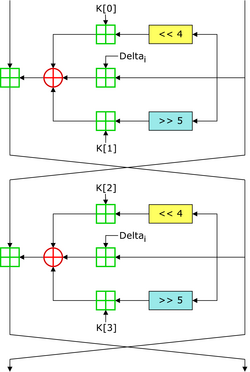
We can indeed recognize the shift operations specific to the algorithm.
By searching for and testing a python implementation of the algorithm, we quickly notice that the decryption result differs between the two implementations. Indeed, the challenge uses different constants (0x9E3779B9 was replaced with 0xBC7F2023).
By modifying the constants of the python algorithm, we get a correct implementation that decrypts the message:
# coding: utf-8
"""
Implementation of the Tiny Encryption Algorithm (TEA) for Python
https://en.wikipedia.org/wiki/Tiny_Encryption_Algorithm
Example Usage:
import tea
# The key must be 16 characters
key = '0123456789abcdef'
message = 'Sample message for encryption and decryption.'
cipher = tea.encrypt(message, key)
assert message == tea.decrypt(cipher, key)
"""
import base64
import ctypes
import itertools
import math


def encrypt(plaintext, key):
    """
    Encrypts a message using a 16-character key.
    :param plaintext:
        The message to encode.  *Must* be a utf8 string but can have any length.
    :param key:
        The encryption key used to encode the plaintext message.  *Must* be a utf8 string and 16 characters long.
    :return:
        A base64 utf8 string of the encrypted message.
    """
    if not plaintext:
        return ''

    v = _str2vec(plaintext.encode())
    k = _str2vec(key.encode()[:16])
    bytearray = b''.join(_vec2str(_encipher(chunk, k))
                         for chunk in _chunks(v, 2))

    return base64.b64encode(bytearray).decode()


def decrypt(ciphertext, key):
    """
    Decrypts a message using a 16-character key.
    :param ciphertext:
        The encrypted message to decode as a base64 utf8 string.
    :param key:
        The encryption key used to encode the plaintext message.  *Must* be a utf8 string and 16 characters long.
    :return:
        A utf8 string of the decrypted message.
    """
    if not ciphertext:
        return ''

    k = _str2vec(key.encode()[:16])
    v = _str2vec(base64.b64decode(ciphertext.encode()))

    return b''.join(_vec2str(_decipher(chunk, k))
                    for chunk in _chunks(v, 2)).decode()


def _encipher(v, k):
    """
    TEA encipher algorithm.  Encodes a length-2 vector using a length-4 vector as a length-2 vector.

    Compliment of _decipher.
    :param v:
        A vector representing the information to be enciphered.  *Must* have a length of 2.
    :param k:
        A vector representing the encryption key.  *Must* have a length of 4.
    :return:
        A length-2 vector representing the encrypted information v.
    """
    y, z = [ctypes.c_uint32(x)
            for x in v]
    sum = ctypes.c_uint32(0)
    delta = 0x9E3779B9

    for n in range(32, 0, -1):
        sum.value += delta
        k1 = (z.value << 4)
        k2 = (k1 + k[0]) ^ (z.value + sum.value)
        k3 = ((z.value >> 5) + k[1])
        k4 = (k2 ^ k3)
        y.value += k4
        z.value += (((y.value << 4) + k[2]) ^ (y.value + sum.value)) ^ ((y.value >> 5) + k[3])
    return [y.value, z.value]


def _decipher(v, k):
    """
    TEA decipher algorithm.  Decodes a length-2 vector using a length-4 vector as a length-2 vector.

    Compliment of _encipher.
    :param v:
        A vector representing the information to be deciphered.  *Must* have a length of 2.
    :param k:
        A vector representing the encryption key.  *Must* have a length of 4.
    :return:
        The original message.
    """
    y, z = [ctypes.c_uint32(x)
            for x in v]
    delta = 0xBC7F2023
    sum = ctypes.c_uint32(0x8fe40460)  #  sum is (delta << 5) & 0xFFFFFFFF, see https://en.wikipedia.org/wiki/Tiny_Encryption_Algorithm

    for n in range(32, 0, -1):
        z.value -= (y.value << 4) + k[2] ^ y.value + sum.value ^ (y.value >> 5) + k[3]
        y.value -= (z.value << 4) + k[0] ^ z.value + sum.value ^ (z.value >> 5) + k[1]
        sum.value -= delta

    return [y.value, z.value]


def _chunks(iterable, n):
    """
    Iterates through an iterable in chunks of size n.
    :param iterable:
        Any iterable.  Must have a length which is a multiple of n, or the last element will not contain n elements.
    :param n:
        The size of the chunks.
    :return:
        A generator that yields elements in chunks of size n.
    """
    it = iter(iterable)
    while True:
        chunk = tuple(itertools.islice(it, n))
        if not chunk:
            return
        yield chunk


def _str2vec(value, l=4):
    """
    Encodes a binary string as a vector.  The string is split into chunks of length l and each chunk is encoded as 2
    elements in the return value.

    Compliment of _str2vec.
    :param value:
        A binary string to encode.
    :param l:
        An optional length value of chunks.
    :return:
        A vector containing ceil(n / l) elements where n is the length of the value parameter.
    """
    n = len(value)

    # Split the string into chunks
    num_chunks = math.ceil(n / l)
    chunks = [value[l * i:l * (i + 1)]
              for i in range(num_chunks)]
    d = [sum([character << 8 * j
                 for j, character in enumerate(chunk)])
            for chunk in chunks]
    return d


def _vec2str(vector, l=4):
    """
    Decodes a vector to a binary string.  The string is composed by chunks of size l for every two elements in the
    vector.

    Compliment of _str2vec.

    :param vector:

        An even-length vector.
    :param l:
        The length of the chunks to compose the returned string.  This should match the value for l used by _str2vec.
        If the value used is smaller, than characters will be lost.
    :return:
    """
    return bytes((element >> 8 * i) & 0xff
                 for element in vector
                 for i in range(l)).replace(b'\x00', b'')


key = '[BreizhCTF_2023]'
cipher = "E+ag9V2E9ONjwkJRyMksO40fc/KdqPPjbVIhpfWh1pfy8jg7Bv/TFvK9s+3j3HWrys21jW8Y45w="
print(decrypt(cipher, key))
Bravo, le flag est BZHCTF{WouldYouLikeACupOfTeaCipher?}.Flag
BZHCTF{WouldYouLikeACupOfTeaCipher?}
Author: Zeecka