
A ChatGPT query supposedly “drinks” half a litre of water. The figure has been everywhere: in the press, on social media, all the way to prime-time TV news. It is wrong. Or rather, it is a real figure copied badly, stripped of its scope and outdated by years. This article goes back to the source 😉 to establish what AI actually consumes, what it gives back too, and where the debate really deserves to take place.
TL;DR
- A text AI query consumes between 0.3 mL and 45 mL of water depending on what gets counted. The media’s “half litre per query” is a mis-copied, outdated figure: even the author of the original study now says ~15 mL.
- Most of AI’s water footprint is indirect (power plants) or industrial (chip manufacturing), not in the data center itself.
- A year of heavy use (100 queries a day) ≈ 1,600 L on a full life cycle basis: less than a pair of jeans, less than 2 kg of beef.
- The real issues: generative video and agents (up to 1,000 times the cost of a text query), data centers badly sited in water-stressed basins, and the sector’s lack of transparency.
- On the other side, AI also saves water and energy (leak detection, irrigation, weather, cooling) and advances medicine. An honest balance sheet counts both columns.
Eco-anxiety, a legitimate starting point
The word entered the French dictionary Le Robert in 2023, and the American Psychological Association was describing it as early as 2017 as a “chronic fear of environmental doom”. The phenomenon is massive and documented: according to the reference study published in The Lancet Planetary Health in 2021 across 10,000 young people in ten countries, 59% of 16-25 year olds describe themselves as “very or extremely worried” about climate change, and more than 45% say those feelings weigh on their daily life.
Every major technology inherits that anxiety in its turn, and the social reflex is anything but absurd: digital technology has very real environmental costs, long kept quiet. Streaming, blockchain and 5G each had their trial, where genuine issues got mixed up with false numbers. Generative AI is the latest to take the stand, with one peculiarity: no technology has ever been adopted this fast, and no shock figures have ever travelled this far. In France (CRÉDOC digital barometer 2025, Talan/Ifop 2025):
- 48% of French people already use generative AI, a faster diffusion than the smartphone’s;
- 46% consider it more polluting than search engines, 17% think the opposite, and among non-users the environmental impact ranks among the main deterrents;
- and yet the top three AI worries remain personal data (65%), copyright (64%) and technological dependence (60%)… the environment is not among them.
The worry is real but diffuse, fed by a handful of viral figures. Those are what need examining. Because the underlying concern is well founded: fresh water is a major issue. Agriculture absorbs about 70% of global withdrawals according to the FAO, industry around 19%, domestic uses the rest, and entire regions live under chronic water stress. So the question is not whether water matters. It does. The question is how much of it AI actually consumes, where, and compared to what.
Anatomy of a viral figure: the famous half litre
It all starts with a serious academic study, “Making AI Less ‘Thirsty’” (Li, Yang, Islam and Ren, UC Riverside and UT Arlington, April 2023). It stated that GPT-3 “needs to drink a 500 mL bottle of water for roughly 10 to 50 medium-length responses”. Read that sentence again: 500 mL for 10 to 50 responses, which means 10 to 50 mL per response, not 500.
That original figure already rested on three methodological choices worth keeping in mind:
- It includes the water of power plants. Most of the volume is not the water cooling the servers, but the water evaporated by the plants (hydroelectric dams in particular) that generate the electricity. In the United States, producing 1 kWh “consumes” on average 3.1 litres of water through that channel.
- It covers GPT-3, a 2020 model, running on the hardware of that era.
- It depends enormously on location: from one data center to another, the same calculation varies by up to a factor of 80 between Arizona and Ireland.
Then the media machine took over. In September 2024, the Washington Post, with the same Riverside team, ran “a bottle of water per 100-word email” (519 mL, precisely). The analyst Andy Masley dissected that figure: out of the 519 mL, about 2 mL correspond to data center cooling. Everything else is water attributed to electricity generation, computed from an energy assumption (140 Wh per email) that was itself overestimated by a factor of 54 to 270, extrapolated to a fantasy GPT-4 with 1,800 billion dense parameters, ignoring its actual architecture.
In France, the final shortcut (“one ChatGPT query equals 50 cl of water”) settled quietly into newsrooms, all the way to the infographic aired on France Télévisions’ prime-time news on 26 October 2025, taken apart by Les Électrons Libres and then by Next.ink. The latter offers a very simple sanity check. At 2.5 billion ChatGPT queries per day, 50 cl per query would add up to about 450 million m³ per year, or 43 times the total water consumption of Microsoft worldwide (10.4 million m³ in 2024, all data centers included). The figure simply fails the plausibility test.
What do recent measurements say? Here are the figures published in 2025 and 2026, with their scope, because that is where everything plays out:
| Source | Per text query | What gets counted |
|---|---|---|
| Google, August 2025 (published study) | 0.26 mL of water, 0.24 Wh, 0.03 g CO₂e (median Gemini prompt) | On-site cooling only, detailed methodology (chips, host, idle machines, PUE) |
| Sam Altman, June 2025 | ~0.32 mL, 0.34 Wh (average ChatGPT query) | Scope unspecified, unaudited figure |
| Epoch AI, February 2025 (independent estimate) | ~0.3 Wh (GPT-4o) | Energy only; ten times below the 3 Wh estimate that had been circulating |
| Mistral AI, July 2025 (LCA reviewed by third parties, with ADEME and Carbone 4) | 45 mL of water, 1.14 g CO₂e (400-token response) | Full life cycle: electricity water, amortized training, server manufacturing |
| Shaolei Ren, 2026 revision | ~15 mL per GPT-4 prompt, including ~5 mL on-site | Updated scopes 1 and 2 |
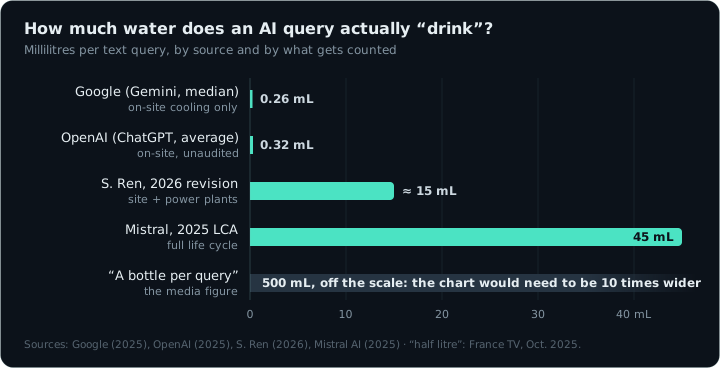
This table tells three stories:
- The honest order of magnitude for a text query goes from a fraction of a millilitre (cooling water alone) to a few dozen millilitres (full life cycle). Even the most inclusive figure, Mistral’s 45 mL, which counts everything down to server manufacturing, stays ten times below the media half litre.
- These figures can only be compared at equal scope. Ren publicly criticizes Google for excluding the indirect water of electricity, and he has a point. But the reverse is just as true: presenting the water evaporated by a dam as water “drunk by ChatGPT” is what manufactured the half-litre panic.
- Everyone has revised downwards, including the author of the original study, who went from 500 mL for a handful of queries to about 15 mL per query.
A bit of plumbing: how a data center consumes water (or doesn’t)
To judge these numbers, three distinctions are needed that almost no mainstream article takes the time to make.
Withdrawing is not consuming. Withdrawn water is pumped and then largely returned to the environment. Consumed water is the part that evaporates and does not come back locally. Confusing the two inflates figures by a factor of 10 to 20.
There are several ways to cool servers, and they have nothing in common. Evaporative cooling, in an open circuit, evaporates water to shed heat: 70 to 80% of the withdrawn water goes into the atmosphere. It is water-hungry (1.5 to 3 L/kWh) but energy-efficient, and Google stands by that choice: its water-cooled data centers consume about 10% less electricity than the air-cooled equivalent. That trade-off structures the whole topic: saving water costs energy, and vice versa. At the opposite end, the closed loop (direct-to-chip liquid cooling, immersion) is filled once at construction, and the water then circulates indefinitely. Consumption in operation: practically nothing. Microsoft announced in December 2024 that all its new data centers will consume zero water for cooling, saving more than 125 million litres per year per site, with the first ones coming online in late 2027. That leaves air cooling: zero water, but more electricity.
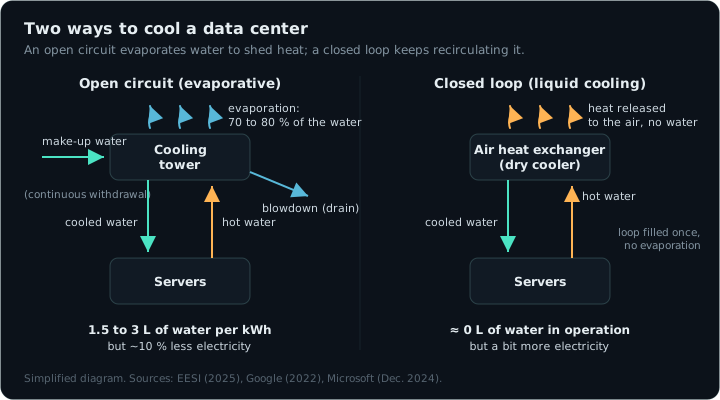
The industry’s indicator is called WUE (Water Usage Effectiveness, in litres per IT kWh):
- the sector’s historical average: ~1.8 L/kWh;
- Google: 1.1 (the evaporative choice, owned);
- Microsoft: 0.30 and then 0.27, a 90% drop in twenty years;
- AWS: 0.15;
- and the US federal laboratory LBNL computes a much lower real fleet average, around 0.36 L/kWh, since many sites are air-cooled.
Cooling does not require drinking water, and operators are moving away from it bit by bit. Google uses recycled or non-potable water on more than a quarter of its campuses: its Douglas County site in Georgia has been running since 2012 on treated municipal wastewater, and its Hamina site in Finland on water from the Baltic. Microsoft reports 99% recycled water in Singapore and 79% in San Antonio. AWS cools 24 data centers with recycled water and targets 120 sites by 2030. This remains a minority of the global fleet, but the direction is clear.
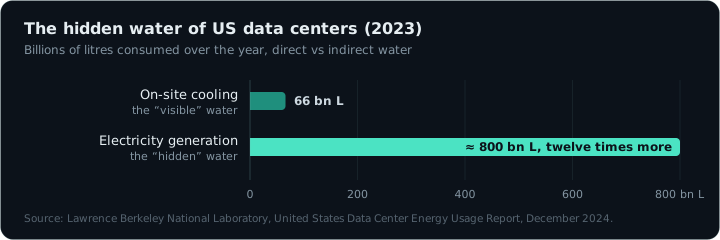
And then there is the hidden water, the one nobody talks about even though it dominates everything: electricity. In the United States in 2023, according to the LBNL, data centers directly consumed 66 billion litres, and indirectly nearly 800 billion through their power supply. Twelve times more. That water depends on the energy mix: a thermal or nuclear plant with cooling towers evaporates about 2 L/kWh, some large dams much more through reservoir evaporation, while solar and wind consume almost nothing. Decarbonizing data center electricity therefore also means dehydrating it.
AI’s three thirsts
Cooling (operations). The item covered above: from a few tenths of a millilitre to a few dozen millilitres per query depending on the chosen scope.
Manufacturing (the hardware). A more discreet and yet heavier item. A semiconductor fab swallows around 38 million litres of ultra-pure water per day. TSMC, which etches nearly all AI chips, consumed about 101 billion litres in 2023, roughly three times all of Google’s data centers. The industry recycles massively (86% of process water at TSMC, with a target of 90% and above in Arizona), but the 2021 Taiwanese drought, with its fabs supplied by tanker trucks while agricultural irrigation was cut off, was a reminder that this item is anything but a footnote.
Training (the models). GPT-3’s training was estimated at 700,000 litres evaporated on site, 5.4 million counting the water of electricity. Two Olympic swimming pools, for a model then served to hundreds of millions of users: it is a fixed cost, amortized over billions of queries. In Mistral’s life cycle analysis, training included, the total indeed lands back at 45 mL per response. The real scandal lies elsewhere: no large American lab has published the training water of its recent models, not GPT-4, not Gemini, not Llama. Mistral remains, to this day, the only company to have published a complete LCA reviewed by third parties.
Not all uses are equal, far from it
Talking about “the” cost of “AI” is like talking about the cost of “transport” while lumping together bicycles and A380s. Published measurements span more than three orders of magnitude:
| Use case | Energy per operation | Source |
|---|---|---|
| Text classification | ~0.002 Wh | Luccioni et al., ACM FAccT 2024 |
| Chatbot-style text query (median) | ~0.24 to 0.3 Wh | Google, Epoch AI |
| Generating an image | ~2.9 Wh, up to 11.5 for large models (a smartphone charge) | Luccioni et al., MIT Tech Review |
| Long query to a reasoning model (o3, DeepSeek-R1) | 30 Wh and above | Jegham et al., 2025 |
| Agentic query (tool-using 70B model, multi-step) | ~348 Wh, or 137 times a standard query | KAIST, IEEE HPCA 2026 |
| 5 seconds of generated video | ~940 Wh, about 700 times an image | MIT Tech Review, May 2025 |
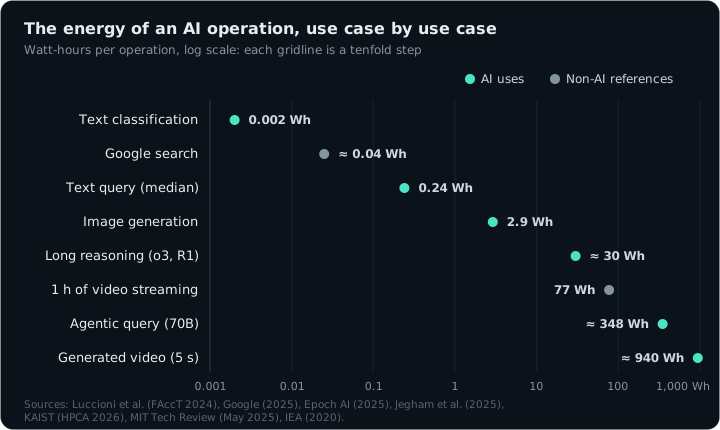
To anchor these numbers in everyday gestures: taking a photo with your phone (~0.01 Wh), sending an email excluding writing time (~0.1 Wh), fully charging a smartphone (~12 Wh), watching an hour of streaming video (~77 Wh).
In other words, the question “does AI consume too much?” has no single answer. Asking a chatbot for a recipe, in writing or by voice, costs the equivalent of a few seconds of television. Churning out videos to feed a TikTok stream, or running fleets of autonomous agents around the clock, plays in a category a thousand times higher. That is where the real sobriety issue lies, not in personal conversational use. Efficiency, meanwhile, is improving at full speed: Google reports having divided the energy of its median prompt by 33 in one year.
The digital world before AI was never free either
A useful reminder, since we have all been using these services without a second thought for fifteen years.
The Google search. It cost 0.3 Wh according to Google in 2009; current estimates sit closer to 0.04 Wh. The famous “ChatGPT equals ten Google searches” therefore compares a modern estimate on one side with a 2009 figure on the other. The gap exists, but both terms of the comparison have moved.
Streaming. An hour of video is about 77 Wh according to the IEA, of which 72% goes to your screen, 23% to the network and only 5% to the data center. The maths is quick: an hour of Netflix is worth about 250 Gemini queries, and nobody feels guilty at minute 251 of a series. The sector has already had its own numbers panic, by the way: the Shift Project’s 2019 estimates, too high by a factor of 4 to 8, rested among other things on a bits/bytes confusion later acknowledged by its authors.
Email. The infamous “4 grams of CO₂ per email” dates from 2010, its own author has disowned it, and the CNRS took it apart: deleting your emails is a symbolic gesture, since the digital footprint comes mostly from manufacturing our devices.
Gaming. A console draws about 200 W, the equivalent of one AI-generated image every 50 seconds, for hours on end.
To place the whole picture: the world’s data centers, AI included, represent about 1.5% of global electricity in 2024, perhaps 3% in 2030 according to the IEA. In France, the entire digital sector weighs 4.4% of the carbon footprint, and half of that total comes from manufacturing our equipment, not from servers.
Solving a problem by hand or with AI: the calculation nobody does
A concrete case: a software bug, an administrative procedure, a summary to write.
- The classic method: half an hour on a computer (30 to 200 W depending on whether it is a laptop or a desktop with a monitor), a dozen Google searches, tabs everywhere, trial and error. Total: 15 to 100 Wh. If one insists on converting to water through electricity, as the alarmist studies do, at 3 L/kWh that gives 50 to 300 mL.
- The AI method: two or three queries (often a single one is enough), five minutes of reading. Total: 5 to 10 Wh, or 15 to 30 mL at the same conversion rate.
The result is counter-intuitive but robust: human screen time dominates the balance, not the query. As soon as AI saves a few minutes, it consumes less than the manual search it replaces. A study published in Scientific Reports in February 2024 pushes the reasoning to its limit: counting human working time, a page written by AI would emit 130 to 1,500 times less CO₂e than a page written by a human. The exact figure is fragile (attributing a writer’s lifestyle to the task is debatable, and the authors admit they do not address rebound effects), but the principle’s order of magnitude holds: reading an article for twenty minutes on a laptop consumes as much as about twenty ChatGPT queries.
The real caveat is the rebound effect. If AI’s convenience multiplies usage, especially heavy usage like video and agents, the unit gain can be eaten by volume. The argument is serious. But it is an argument about our collective uses, not about the guilt of an individual query.
Putting the millilitres in their place
The water footprints below come from the reference work of Mekonnen and Hoekstra for the Water Footprint Network. One clarification that is made far too rarely: these figures aggregate “green” water (rain evapotranspired by crops, 94% of the total for beef), “blue” water (what gets withdrawn for irrigation) and “grey” water (the theoretical volume needed to dilute pollutants). Green water does not empty aquifers. But even counting only blue and grey, the orders of magnitude remain telling.
| Water consumed (order of magnitude) | In AI queries* | |
|---|---|---|
| 1 text query (on-site cooling) | ~0.3 mL, five drops | 1 |
| 1 text query (full life cycle, Mistral) | ~45 mL | 1 |
| 1 toilet flush | 3 to 9 L | 10,000 to 30,000 (on-site) / ~130 (LCA) |
| 1 five-minute shower | 60 to 80 L | ~200,000 / ~1,500 |
| 1 cup of coffee | ~130 L, mostly green water | ~430,000 / ~2,900 |
| Daily domestic use of a French resident | ~148 L | ~490,000 / ~3,300 |
| 1 litre of milk | ~1,020 L | ~3.4 M / ~23,000 |
| 100 g of beef | ~1,540 L, of which ~93 L of blue and grey water | ~5 M / ~34,000 |
| 1 cotton t-shirt | ~2,700 L | ~9 M / ~60,000 |
| 1 pair of jeans | 3,800 to 10,000 L | 13 to 33 M / 85,000 to 220,000 |
| 1 smartphone (manufacturing) | ~12,000 L | ~40 M / ~270,000 |
| Filling a private swimming pool | ~19,000 L | ~63 M / ~420,000 |
* Author’s calculations, at 0.3 mL (on-site cooling, Google and OpenAI figures) or 45 mL (full life cycle, Mistral) per query. Rounded.
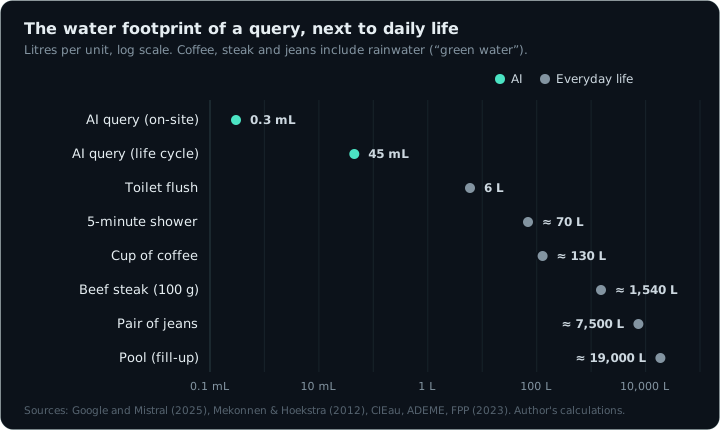
What this table says: even under the scope least favourable to AI, a 100 g steak is “worth” 34,000 queries, a shower 1,500, a smartphone 270,000. A heavy user sending 100 queries a day for a whole year would consume, on a full life cycle basis, about 1,600 litres. Less than two kilos of beef. Less than a pair of jeans.
Same exercise at the macro scale. The world’s data centers consume about 560 billion litres of water per year according to the IEA, indirect water included, or 0.56 km³, to be set against the roughly 2,800 km³ withdrawn by global agriculture. In the United States, golf courses irrigate with about 2 billion gallons per day, four to five times more than the direct consumption of all the country’s data centers.
Where the debate is legitimate
Playing down the global averages does not give anyone licence to sweep the real problems aside. They exist, but they are elsewhere.
Local concentration. Water is a watershed issue, not a planetary-average issue. In The Dalles, Oregon, Google’s data centers absorb more than a quarter of the town’s water, around 40% in 2025. In Uruguay, a Google project announced during the country’s worst drought in 74 years brought protesters into the streets before being converted to air cooling. In Spain, projects in drought-stricken areas have had to be scaled back. An average data center does not dry out a country; a badly sited data center can put a small town under stress.
Growth. The direct consumption of American data centers tripled between 2014 and 2023 and could double or even quadruple again by 2028 according to the LBNL. Ren’s study projects 4.2 to 6.6 billion m³ of withdrawals for global AI in 2027. Per-query efficiency gains are spectacular, but the total-volume question remains wide open.
Opacity. It may be the most irritating part of the whole file. The town of The Dalles sued a local newspaper for thirteen months, in proceedings funded by Google, to prevent the publication of its consumption figures. OpenAI has never published a methodology. The reassuring numbers of 2025 are partly corporate self-declarations. Mistral-style transparency (a complete LCA, independently reviewed) should be the norm, not the exception. It is probably the most useful demand the public debate can carry.
The other column of the ledger: what AI saves (water, energy, health)
An honest balance sheet also has to fill in the other column.
On water itself. In France, distribution networks lose to leaks nearly 20% of the drinking water they carry, about one billion m³ per year according to the SISPEA observatory. Targeting algorithms now let utilities focus leak detection on the riskiest segments: in pilot areas, losses were cut in half, saving 105,000 m³ per year. At the “full life cycle” rate, that is several billion queries’ worth. In agriculture, which concentrates 70% of the world’s water on its own, sensor-and-AI-driven irrigation demonstrates 25 to 40% water savings in documented trials, from Bordeaux vineyards to the El Guerdane scheme in Morocco.
On energy. As early as 2016, DeepMind cut the cooling energy of Google’s data centers by 40% (around 30% sustained since the switch to autonomous control). AI weather forecasting (GraphCast in Science in 2023, GenCast in Nature in 2024) beats the best physical models on nearly every tested variable, in one minute of compute on a single chip where hours of supercomputer time used to be needed. Google’s Flood Hub freely warns 700 million people in 100 countries about flood risk. Further out: fusion plasma control through reinforcement learning (Nature, 2022, DeepMind and EPFL) and 2.2 million crystal structures predicted by GNoME for tomorrow’s batteries and superconductors, 736 of which have already been synthesized by independent teams.
On health. AlphaFold, 2024 Nobel Prize in Chemistry, has put 214 million protein structures in the hands of more than 3 million researchers across 190 countries. In breast cancer screening, the Swedish randomized MASAI trial, run on 100,000 women, shows 29% more cancers detected with no increase in false positives, and a 44% lighter reading workload for radiologists. Deep learning has enabled the discovery of new antibiotics against multi-resistant bacteria (halicin in Cell in 2020, abaucin in Nature Chemical Biology in 2023). None of these results cancels out litres of water on a ledger. But a debate that counts the millilitres of queries while ignoring these columns is not a balance sheet, it is an indictment.
What companies actually do, and what to keep an eye on
The verifiable facts first:
- Water. Microsoft announced it had reached its “water positive” goal, returning more water than it consumes, as early as 2025, five years ahead of schedule, through 76 restoration projects. Google replenished 78% of its consumption in 2025 and targets 120% by 2030. Meta and AWS have made comparable commitments. Above all, Microsoft’s “zero-water” designs and the rise of the closed loop attack the problem at the root rather than through offsets.
- Energy. Amazon, Meta, Google and Microsoft together account for 49% of the world’s corporate clean energy purchases in 2025 according to BloombergNEF. Google aims to run carbon-free around the clock by 2030 (66% achieved on an hourly basis) and cut its data centers’ emissions by 12% in 2024 even as their electricity consumption rose by 27%.
- Nuclear. The turn is under way: the restart of Three Mile Island for Microsoft, with a twenty-year contract on 835 MW, and small modular reactors for Google with Kairos and Amazon with X-energy. A useful reminder: fewer thermal power plants means less water evaporated exactly where most of AI’s water footprint hides.
Now the caveats, because independence demands them. These balance sheets are self-declared. “Water positive” sometimes compares contracted replenishment with actual consumption, without guaranteeing that the returned water goes back to the stressed watershed. And the sector’s overall growth can swallow the unit gains. These commitments are real and measurable; they deserve to be tracked, not recited.
Moving the cursor to the right place
At the end of this deep dive into the numbers, three conclusions emerge.
- Personal AI use is a non-issue for water. A text query sits between five drops and three tablespoons of water depending on the scope, and an entire year of your queries weighs less than your jeans. Guilt-tripping the user who asks for a recipe or gets an email proofread is a scale error, exactly like yesterday’s “delete your emails for the planet”. Eco-anxiety is legitimate, but it deserves to be invested where the litres are real: food, mobility, housing, and on the digital side the renewal rate of our devices, which weighs more than all the servers.
- AI’s real issues are specific and localized: mass video generation and agent fleets (a thousand times the cost of a text query), data centers sited in already stressed watersheds, the water behind chip manufacturing, the sector’s aggregate growth. That is where public and regulatory pressure is useful, not on the five drops.
- Transparency remains the fight to be won. The half-litre fiasco thrived on the void left by the companies themselves. As long as OpenAI, Google or Meta do not publish complete, audited life cycle analyses, as Mistral did, incomparable scopes will keep producing sometimes panic, sometimes complacency.
The debate on water and AI deserves better than imaginary bottles. It deserves meters.
A note on method. Throughout this article, a distinction is drawn between withdrawn and consumed water; between on-site cooling water, the water of electricity generation, and the full life cycle (manufacturing and training included); and between green, blue and grey water for the agricultural comparisons. The query equivalences are the author’s calculations, flagged as such, given at both ends of the scope range (0.3 mL and 45 mL). The figures from Google, OpenAI, Microsoft, Amazon, Meta and Mistral are corporate declarations, only one of which (Mistral) is a third-party-reviewed LCA; the academic critiques of those figures, notably Shaolei Ren’s, are cited. In a field where efficiency moves this fast, any figure older than 2024 should be read as a probable upper bound. Sources last checked: August 2026.